
Hire an AI team member: what UK founders need to know
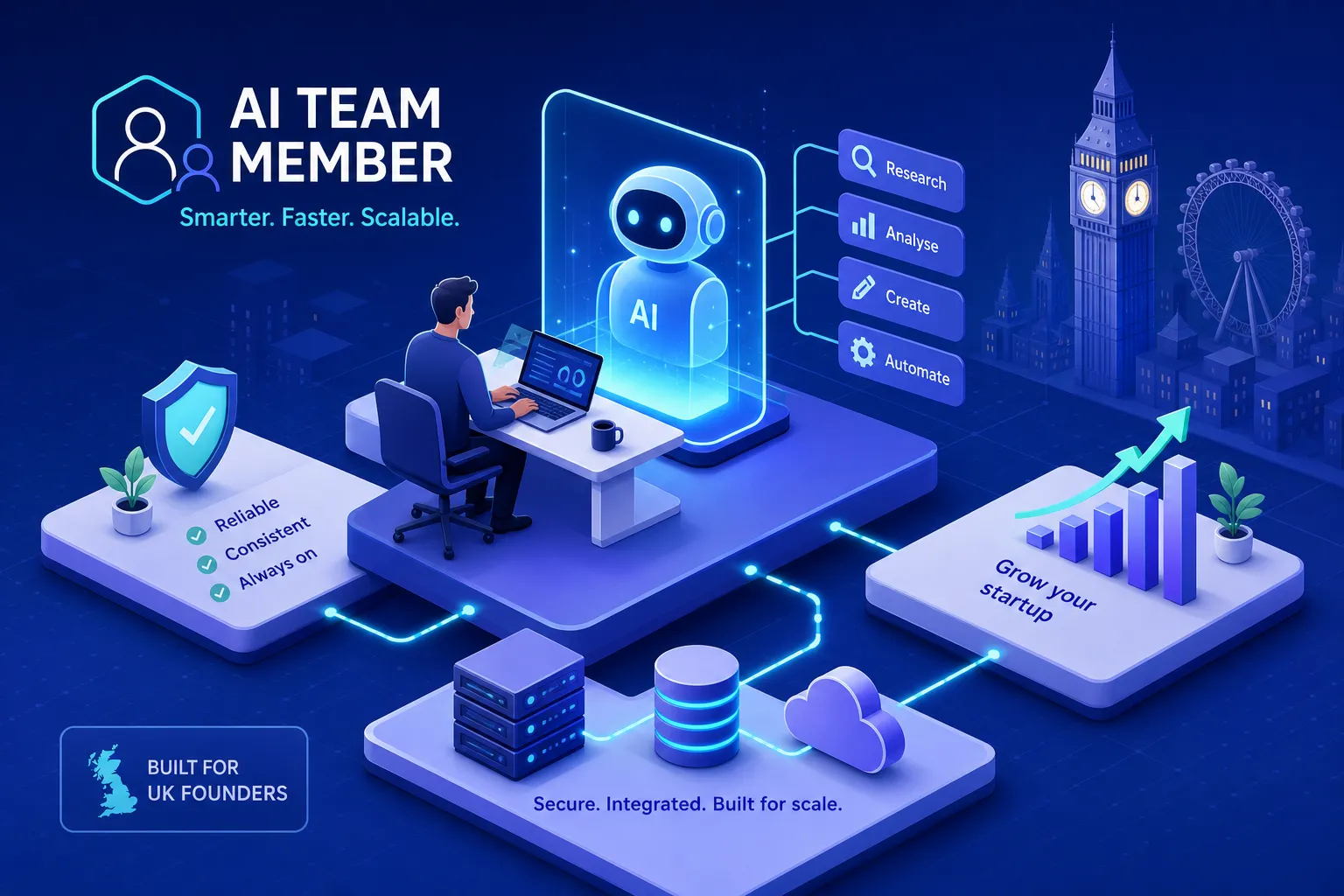
If you want to hire an AI team member, the most common mistake is treating it like buying a printer. Many founders pick something off a list, plug it in, and wait for it to work. When it doesn't, they blame the technology. The problem, almost always, is that nobody gave it a job.
An AI team member is only useful when it has a defined role, clear expectations, and a proper brief, the same logic you'd apply to any new starter. The founders who get the most from AI agents aren't the ones who picked the most impressive-sounding platform. They're the ones who did the thinking first: what does this role actually involve, what does done look like, and how will we know if it's working? This guide walks through exactly that process, whether you're leaning towards buying a ready-made specialist agent, recruiting human AI talent, or building something bespoke from scratch.
What "hiring" an AI team member actually means
There's a meaningful difference between buying AI software and adding an AI teammate to your business. Most people buy AI the same way they buy a spreadsheet template: install it, hope it works, never really configure it properly. The result is a tool that sits idle or delivers mediocre output. An AI team member, by contrast, is something you give a job to. It has scope, boundaries, and a measure of success.
That distinction changes how you deploy it, brief it, and hold it accountable. Some platforms take this principle seriously: rather than handing you a blank tool, they supply each agent with a readable profile listing defined skills, example tasks, tools used, rules followed, and known limitations. Grange Labs follows this approach with its roster of specialist AI agents, each of which comes with exactly that kind of structured briefing document. The right way to work with an AI agent is the same way you'd work with a new hire: brief it on the role, set the parameters, and let it get on with the work. Platforms built around this principle can significantly reduce the need for specialist prompt engineering, which is part of what makes them accessible for founders who aren't technical.
How to define the role before you commit to anything
Before you evaluate a single platform or agent, write down the tasks you'd hand off on day one. Be specific: not "admin" but "respond to new customer enquiries within two hours" or "turn each podcast episode into three social media posts and a newsletter section." Vague briefs produce vague results, whether you're managing a human or an AI. Common starting points for small UK businesses include inbox triage, booking management, content repurposing, and sales follow-up sequences. These are high-volume, rules-based tasks that don't require fresh judgement on every step, which makes them ideal for a first AI-powered employee deployment. If you want a structured checklist to work from, consider running an AI Readiness Audit.
A good role brief for an AI agent covers four things: the trigger (what starts the task), the output (what done looks like), the rules (what it should never do), and the escalation path (when it should flag something for a human). You don't need technical language to write this. If you can explain the job to a new employee on their first day, you can brief an AI agent the same way. The businesses that struggle with AI adoption are usually the ones that skipped this step, not the ones that chose the wrong tool.
Buy, build, or recruit: choosing the right route
The fastest route is a vendor-supplied agent with a defined role, preconfigured tools, and a subscription price. In 2026, entry-level options start from around £3 to £10 per user per month, while more capable specialist agents sit in the £25 to £80 range. Multi-agent platforms with CRM integration typically run between £500 and £2,000 per month at the mid-tier, though it's worth noting these figures reflect approximate market rates and will vary by vendor, configuration, and whether VAT is included. The key question to ask any vendor is the all-in price: headline rates often exclude platform fees, onboarding costs, and per-seat minimums. For a sense of how vendor rates compare across the market, see this enterprise AI pricing comparison.
For context, a part-time employee on a £15,000 base salary costs closer to £21,700 a year once employer National Insurance at 13.8%, pension contributions, holiday pay, and recruitment fees are factored in. Grange Labs positions its full eight-agent workforce at a price point designed to compare favourably with the combined cost of human hires when that full employment overhead is included, a framing worth keeping in mind as you model the numbers for your own business. If you need a refresher on the true employment costs to compare against, see analysis on the true cost of hiring in the UK.
If your business needs someone to build custom AI workflows, connect bespoke data sources, or own AI governance internally, you're in recruitment territory. Roles like no-code automation engineers, MLOps specialists, and prompt engineers are increasingly common in UK SMEs, often hired fractionally or on a project basis. Expect to pay a premium: these are scarce skills. This route makes sense when your needs are complex, your data is sensitive, or you're building proprietary capability. For most small businesses, it's the wrong starting point.
Building a bespoke AI agent from scratch is the third option, and for most small and growing businesses the opportunity cost alone is prohibitive. It requires technical resource, time, and ongoing maintenance. The exception is when you have a highly specific workflow that no existing platform serves. Even then, most founders find it faster to start with a configurable vendor agent and customise from there, rather than building from zero.
How to hire an AI team member on a budget
AI staffing solutions have become far more accessible for smaller businesses. The practical entry point for most founders is a specialist agent platform where the role is already scoped, the tooling is preconfigured, and the briefing process doesn't require a technical background. Rather than committing to a full multi-agent deployment from day one, start with a single AI employee covering one well-defined function, customer enquiry handling, content repurposing, or sales follow-up, and treat that as your proof of concept. The goal in the first phase isn't to maximise automation; it's to learn how your business interacts with an AI teammate before you scale.
Fractional or project-based AI recruitment is another route worth considering if your needs are more complex. Hiring a no-code automation engineer for a defined project, rather than a permanent role, gives you bespoke capability without the ongoing overhead. Compare that cost against a configurable platform before committing either way.
Onboarding your AI agent properly
Onboarding an AI agent follows the same logic as onboarding a human: the more clearly you define the job upfront, the less time you spend correcting mistakes later. Before the agent goes live, confirm three things: what data it has access to, what it's authorised to do without sign-off, and what it must flag for human review. Building human sign-off into the workflow for consequential decisions isn't a sign of distrust. It's good governance, and it's how well-designed AI agent platforms work by default. For guidance on modern employee onboarding approaches that translate well to AI, review industry best practice on modern employee onboarding best practices.
Best practice is to run a structured pilot on a single, well-defined task before scaling. A period of several weeks to a few months gives you enough data to assess performance honestly, shorter for very narrow, low-risk tasks; closer to 90 days if the scope is broader or the stakes are higher. Choose something with a measurable output: response rate, time saved, number of pieces of content produced, or leads followed up. Run it alongside your existing process rather than replacing it entirely. Gather feedback from anyone affected, team members, clients, or customers who interact with the agent, and adjust the brief before scaling. A/B testing the automated process against the manual one gives you honest data rather than an optimistic assumption. Research into AI adoption consistently recommends structured pilots over switching everything over at once, with monitored rollouts producing more sustainable outcomes.
UK GDPR and keeping humans where they need to be
Any AI system that processes personal data in the UK must comply with the UK GDPR and the Data Protection Act 2018. Before deploying an AI agent that handles customer enquiries, booking data, or employee records, conduct a Data Protection Impact Assessment. Check that your vendor has a data processing agreement in place, confirm where data is stored, and ensure it is deleted on a defined schedule. For customer-facing agents, a retention period of 30 to 90 days is typical for conversation logs. Your users should also be informed before any AI interaction begins: a clear privacy notice stating what data is collected, why, and for how long is a legal requirement, not a nice-to-have. Practical guidance on how to ensure GDPR compliance when using AI can be found in this resource on ensuring GDPR compliance with AI.
Automated decision-making that has a legal or significant effect on individuals requires human review capability and a right to explanation. Build that into your workflow from the start, not as an afterthought. Non-compliance carries fines of up to £17.5 million or four percent of annual global turnover. The ICO's guidance is clear that AI used in customer-facing roles constitutes high-risk processing, which means the DPIA obligation applies regardless of the size of your business. For specific legal considerations around AI in the workplace and employer obligations, see commentary on AI in the workplace, legal considerations for employers. If you're deploying through a platform such as Grange Labs, check that their data processing agreement covers UK data residency and that any third-party LLM providers they use are bound by the same obligations.
The metrics that tell you if your AI hire is actually working
Treat your AI team member like any probationary hire: set KPIs and review them at a fixed point. Useful metrics depend on the role but typically include response time, task completion rate, error rate, and the number of escalations to a human reviewer. A high escalation rate in the first few weeks is not a failure; it means your brief needs refining. A persistently high escalation rate after a full trial period means the role scope is wrong.
The goal isn't zero human involvement. It's the right level of human involvement on the decisions that genuinely need it. That's a useful frame for the whole exercise: you're not trying to remove humans from your business. You're trying to free them up for the work that actually requires human judgement. The businesses that use AI agents most effectively are the ones that are clear on that distinction from the start.
The starting point is always the same
Hiring an AI team member is not primarily a technology decision. It's a management decision. The businesses that get the most from AI agents treat them the same way they'd treat a capable new hire: give them a clear job, a proper brief, and time to settle in. For many rule-based, high-volume tasks, the tooling available to UK SMEs in 2026 is mature enough to deliver real results. The harder question, what job do you actually need done, is still yours to answer.
If you're starting from scratch, the simplest route is a specialist agent from a platform where the role is already defined and the briefing process is built for non-technical founders. That's the model Grange Labs was designed around. Each specialist agent comes with a readable profile, a defined scope, and a plain-English briefing process, so you're working from a job description, not a blank configuration screen. You can bring on a single AI employee for a specific role or deploy the coordinated multi-agent workforce under one operational layer. Either way, you start with the job description, not the technology. That's the right order.
Want this in your business?
Book a 30-minute scope call. No pitch, just a straight answer.